Friday, July 11, 2008

ROME - Hotel Mascagni, Trevi Fountain, Spanish Steps, Piazza Barberini

Please see my postscript posting to my stay at the Hotel Mascagni HERE: HOTEL MASCAGNI ROME - BEWARE!!

My visit to Rome starts with a full day of a "field trip" with our Prof.ssa Giulia CERIANI SEBREGONDI (see my previous posting). I am staying at the Hotel Mascagni, which was recommended to me by a client of mine as being a very "refined and elegant" Roman Hotel and having the advantage of being situated in a prestigiously central location, only a short walk away from Via Veneto, Piazza Barberini and the Spanish Steps. It was completely restored in 2005.

image image
It is described on the Hotel Web-site as: "having a sophisticated flavor, simple and elegant and at the same time extremely soothing and welcoming, thanks to the utmost care that the staff gives to their houseguests."
It was redesigned in collaboration with Lorenzo Bellini who is a prominent Italian architect. His web-site has the slogan "the difference is the italian touch" . In the redesign he has maintained its welcoming and informal atmosphere with a more sophisticated style, with furnishings that inspire a re-fashioned classic style; lighter tones in the common areas that, besides giving space a larger dimension, add more luminosity.

imageimage

The Rooms are mixed with light and warm colors, like maroon, that bring out the precious woods of the furniture.
The Hotel holds contemporary art pieces like the sculpture in bronze by the famous artist of ” Nouveau Realism” Fernandez Arman, instead, in the rooms, the walls are enriched with a particular collection of photographs of Rome done in black and white.

imageimage

Special care has been dedicated to lighting, that besides creating a play on light that improves the accessories and furnishings in the rooms, it creates the perfect atmosphere for relaxing.

image image

image image

Nearby Points of Interest

Baths of Emperor Diocleziano - Immediate hotel area
American Catholic Church of S. Susanna - Immediate hotel area
Opera Theatre - Immediate hotel area
Quirinale Palace - Immediate hotel area
S. Bernardo's Church - Behind the hotel
Via Veneto - Walking distance


Trevi Fountain This famous fountain is at the juncture of three roads and it was the Roman custom to build handsome fountain at the endpoint of an aqueduct. This aqueducts supplied water to ancient Rome. In 19 BC, supposedly with the help of a virgin, Roman technicians located a source of pure water some 13 km from the city. (This scene is presented on the present fountain's facade). However, the eventual indirect route of the aqueduct made its length some 22 km (14 miles). This Aqua Virgo led the water into the Baths of Agrippa. It served Rome for more than four hundred years.

image A traditional legend holds that if visitors throw a coin into the fountain, they are ensured a return to Rome. Among those who are unaware that the "three coins" of Three Coins in the Fountain were thrown by three different individuals, a reported current interpretation is that two coins will lead to a new romance and three will ensure either a marriage or divorce. A reported current version of this legend is that it is lucky to throw three coins with one's right hand over one's left shoulder into the Trevi Fountain.

Approximately 3,000 Euros are thrown into the fountain each day and are collected at night. The money has been used to subsidize a supermarket for Rome's needy. The fountain is particularly beautiful at night when it is all lit up.

Trevi Fountain at night.
It has been the filmed in many famous movies:

The Spanish Steps (Italian: Scalinata della Trinità dei Monti) are a set of steps climbing a steep slope between the Piazza di Spagna at the base and Piazza Trinità dei Monti, dominated by Trinità dei Monti, the church that was under the patronage of the Bourbon kings of France, above. The Scalinata is "without a doubt the longest and widest staircase in all Europe.

Image:Spanish-steps.jpgThe monumental stairway of 138 steps was built with French diplomat Étienne Gueffier’s bequeathed funds of 20,000 scudi, in 1723–1725, linking the Bourbon Spanish Embassy to the Holy See.

Piazza Barberini is of course one of the most visited piazzas in Rome where Bernini's glorious Triton Fountain stands. The fountain is one of Bernini's masterpieces in honour of his great protector Urbanus VIII.
The four dolphins carry the coat of arms of the Barberini family while Triton blows a jet of water into the air through a shell held up in his hands.
The Fontana del Tritone
Nearby you can also see the magnificent Barberini Palace whose facade opens up the palace instead of enclosing it within an impermeable block as most other palaces of this epic were constructed.
Construction of the palace began in the early 17th century for the Barberini Family. Originally started by Carlo Maderno, the construction was taken over by Bernini and assisted by Francesco Borromini in 1629 after Maderno's death.

Palazzo Barberini

Thursday, July 10, 2008

ROME - Architecture of the 20th Century

image

Fresco painted by Achille Funi in 1953, depicting diverse scenes on the origins of Rome Palazzio dei Congressi

Below are some of the sites that I will be visiting in July, as part of my course of studies at the University of Architecture in Ferrara. This "field trip" to Rome is part of the course: "History of Italian Architecture 19th - 20th Century Design", with our Professor Dr Giulia CERANI SEBREGONDI. Whereas most visitors to Rome go to the ancient sites, this trip focuses on 20th Century design, which I find interesting to learn more about, and how it figures in the overall concept and planning of a great Historic city like Rome.


Villaggio Olimpico Housing project built for the 1960 Olympic Games

 Image of Villagio ...

The site selected for the 1960 Olympic Games was a strategic location along the ancient Via Flaminia as it intersected the curve of the Tiber a couple of kilometers from northern gate of the city. This area along the flood plain of the Tiber had long been used as a site for sporting events. Previously it had been the Piazza d´Armi for horse events and there was a hippodrome at the base of the hill below Villa Gloria. There was a national stadium here in 1911 and the site was also used for tennis and became the soccer field for the Lazio team. In the 1931 and 1950 Il Piano regolatore this area was designated as a public park and as a district of palazzine apartment buildings. This was an obvious effort to preserve the open, landscaped quality of the site. During this period the area became a zone of scattered buildings and open spaces and it was selected as the site for the Olympic Village for the 1960 Olympic Games. The choice of this site for the 1960 Olympics was also desirable because of the easy access to Foro Italico across the river to the west where facilities built in the 1930's already existed including an Olympic stadium seating 100,000, the swimming and tennis stadiums and other facilities.

In addition to the two stadiums and 1500 or so dwellings, the Olympic Village is a more-or-less complete community including shopping, schools, and a church. Both stadia were positioned to the south leaving the remaining site for the residential community.
 

Palazzetto dello Sport was built for the 1960 Summer Olympics. This building was designed by Pier Luigi Nervi and was opened in 1957. It hosted boxing among other sports during the Olympic Games. Presently the "Palazzetto dello Sport" hosts the most important volley matches of "M.Roma Volley", which is the volleyball team of Rome.

The arena is constructed with prefabricated ribbed concrete shell dome 61m in diameter, braced by concrete flying buttresses. Much of the structure was prefabricated, so that the dome was erected in 40 days

image image


Maxxi Museum The Contemporary Art and Architecture Centre in Rome, formally called the 'Museum of Art for the XXI Century', or MAXXI. This ambitious museum is designed by the London-based architect Zaha Hadid.

image image image


Mosque of Rome
Mosque and Islamic Cultural Center built in 1984 Architect Paolo Portoghesi

 
Mosque in Romeimage

 imageimage

Interior showing laced rib domes


Palazzo della Civiltà del Lavoro was constructed as part of the program of the Esposizione Universale Roma, a large business center and suburban complex, initiated in 1935 by Benito Mussolini for the planned 1942 world exhibition and as a symbol of fascism for the world. It is a large-scale image of how urban Italy might have looked if the fascist regime had not fallen during the war -- large, symmetrical streets and austere buildings of limestone, tuff and marble.

The design of the "Square Colosseum" as it is called, was inspired more to celebrate the Colosseum, and the structure was intended by Benito Mussolini as a celebration of the older Roman landmark. Similar to the Colosseum, the palace has a series of superimposed loggias, shown on the facade as six rows of nine arches each. These numbers are an allusion to the name of the Fascist dictator: "Benito" having six letters and "Mussolini," nine.

image


Museo Della Civilta Romana Projected by Mussolini as part of his grand exhibition, now the suburb of EUR, this museum uses replicas and models to create a history of Rome. A neglected but fascinating Rome attraction. If it weren't for space restrictions in the city, this museum would be an ideal visitor centre to the Roman Forum. As it is, the trip to EUR, although fascinating, deters short-stay tourists and means they miss out on a helpful and interesting account of the development of Rome.

In a grand purpose-built palazzo, the Museo della Civiltà Romana (Museum of Roman Civilisation) tells the story of Rome: from a collection of huts on the seven hills, to a huge city of temples and palaces. Models of the city and monuments at different stages of history help to give a good idea of Rome as it was; more than you can get from surveying ruins and fragments.

image 


Palazzio dei Congressi This Congress Hall offers extensive hosting for fairs, congresses, conferences and exhibitions, and is described as: The meeting place between rationality and art. It was designed to accommodate the 'Universal Exposition of Rome in 1942.

The start of the second World War delayed its construction. The draft of the Palace, dating back to 1938, was completed only in 1954.

From a stylistic point of view, the architect Adalberto Libera, wanted to give it a noble and elegant look with modern lines together with classicism: the sharpness of architectural solutions, clean forms and attention to detail are today what makes the Congress Palace a relevant example of Rationalist Architecture, admired worldwide.

The building houses major works of art produced by important Italian artists of the 20th century. On the back wall of the Kennedy Hall is a fresco painted by Achille Funi in 1953, depicting diverse scenes on the origins of Rome. In the Art Hall there is a polychrome panel of extraordinary beauty, produced in 1953 by Gino Severini, a major Futurist artist and two magnificent mosaics by Angelo Canevari, made in 1940, and located in the café room.

image image


Also Included on this field trip:

- Auditorium
- EUR urban planning
- Eur seat & bar-restaurant
- DC party seat
- Eur Post Office


image

ETR 500 at Milan Central Station.  Milan Train Station

Monday, July 7, 2008

Ferrara - The City and the Walls


Today is my first day in Ferrara, the ancient walled city located in Emilia-Romagna, northern Italy just above Tuscany. It is situated 50 km northeast of Bologna, on the Po di Volano, a branch channel of the main stream of the Po River. The town has broad streets and numerous palaces dating from the 14th & 15th century, when it hosted the court of the house of Este. For its beauty and cultural importance it has been qualified by UNESCO as World Heritage Site. I will be spending the month of July 2008 in this beautiful walled, Medieval City, studying Architecture (see my previous post) at the top ranked University in all of Italy.  I am staying off campus, but I get a bike when I arrive, and will ride back and forth between campus and the Residence.  It is apparently a 10 minute bike ride which is very European and very energy efficient, as well as good exercise.

image_thumb4


The Walls

Arriving in Ferrara the Walls around this historic City constitute your first contact with the city: a red curtain of brick encircles it, almost without interruption for nine kilometers, constituting one of the oldest and most impressive defensive systems of the Middle Ages and the Renaissance.  Within these walls you can find all of the techniques of defence used in the 1400s and 1500s: city gates, bastions, large towers, gun slots and embrasures. Now these walls have been transformed into a place for meeting friends, practicing sport and recreation, with paths for cycling and walking.

image_thumb13 
This is a map of Ferrara and you can see the outlines of the wall around the city which is reportedly 9 kilometers long.

ferrara picture italyferrara picture italy

Picture on left:The city walls and one of the gates into the City of Ferrara
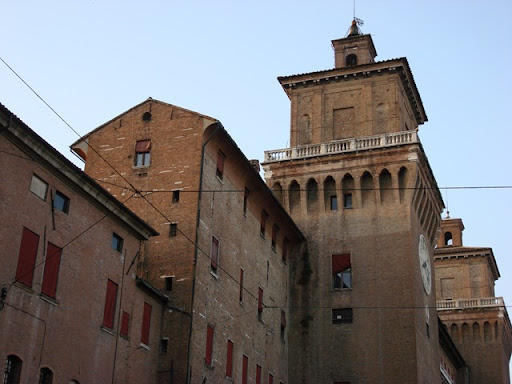
Picture on right: Castello Estense de Ferrara has a working drawbridge.


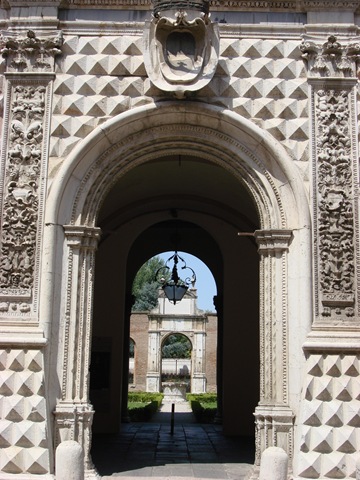
Palazzo dei Diamanti  is one of the most famous palaces in Italy, as well one of the most influential examples of Renaissance European architecture.

2008 07 06_0004 

  2008 07 06_0005

Designed by Biagio Rossetti, it was built starting from 1493 by order of Sigismondo d'Este. The most striking features is the bugnato of the exterior walls: it consist of some 8,500 white (with pink veins) marble blocks carved to represent diamonds, hence the common name "Diamanti". The palace today houses the National Gallery of Art.

   2008 07 06_00172008 07 06_0013
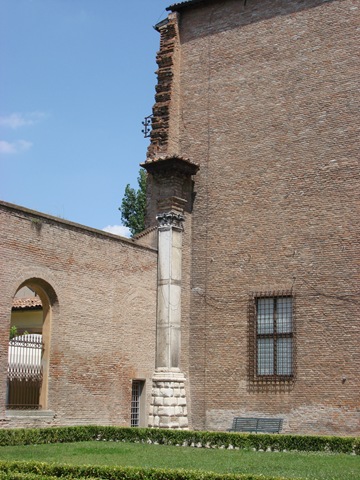
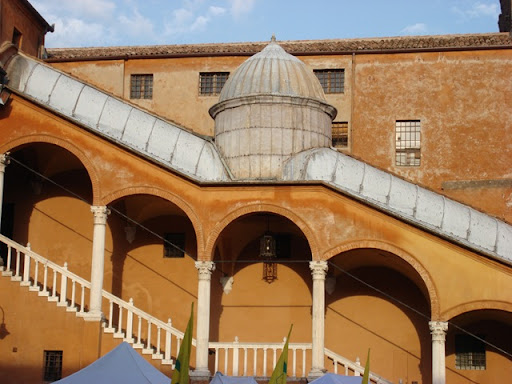
The interior courtyard


2008 07 06_0014 
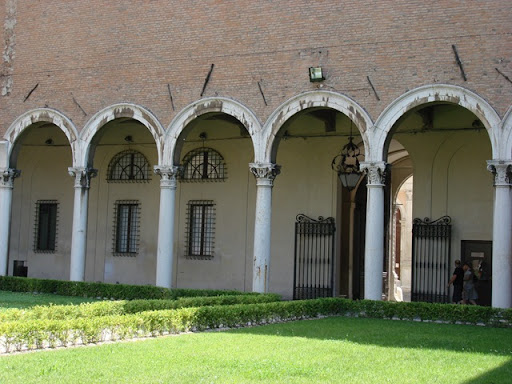
Interior courtyard colonnade 

 2008 07 06_00102008 07 06_0021

Wooden coffered ceiling of the colonnade with detail of a beautiful iron chandelier

2008 07 06_00152008 07 06_0020 
Fountain detail                                                                      Column detail

2008 07 06_0011

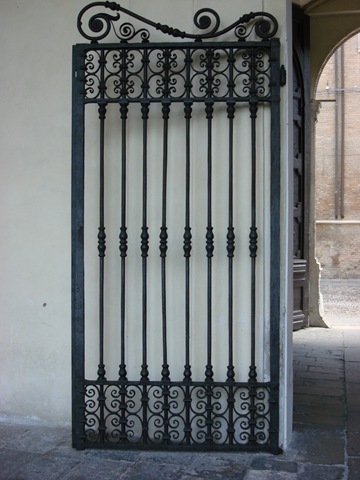
                                                              Iron Gate in colonnade

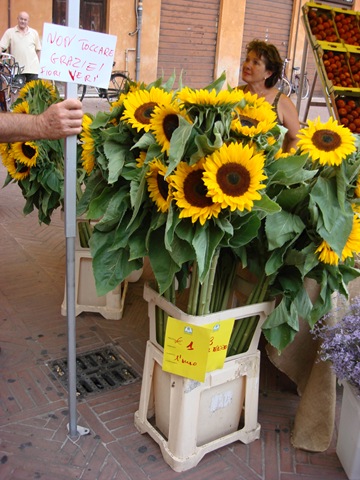
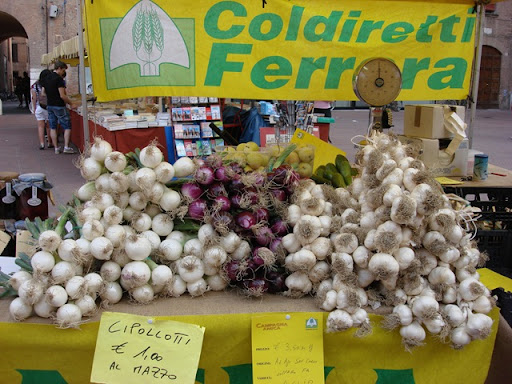
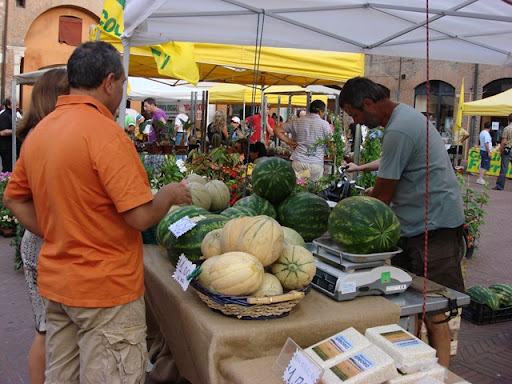
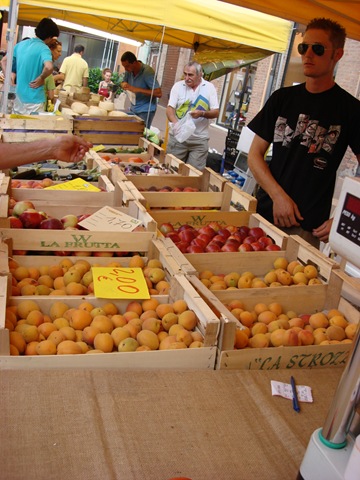
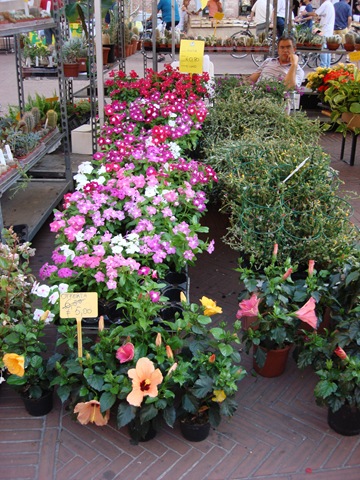
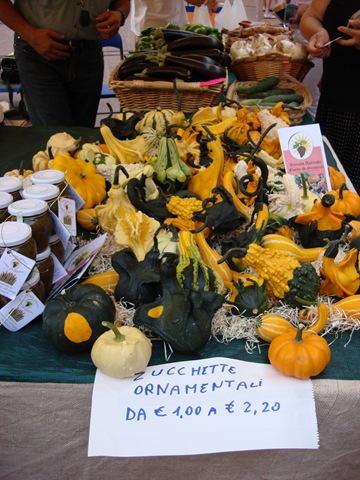
Below are some of the tables in the market in the central piazza. 
2008 07 06_0037
I wanted to buy a bunch of the sunflowers for my room, but two things were against me: 1. I was riding my bike and I am not yet as adept as the Italians in navigating the busy streets packed down with goods, and  2. I did not pack the proper vase in my suitcase to accommodate 3 foot long stems.  So I reluctantly passed. I had to be content just to feast my eyes on them.

2008 07 06_0028   2008 07 06_0033

2008 07 06_0031

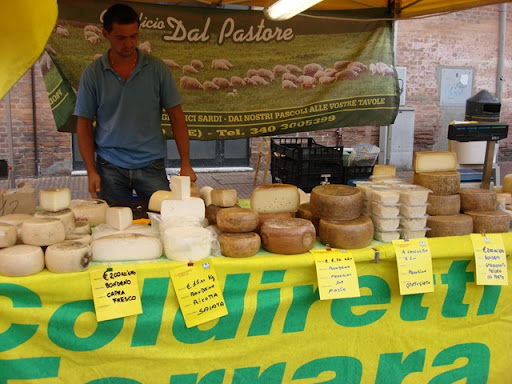
I bought some cheeses from this vendor after tasting slim slivers that he cut off for me.

2008 07 06_00292008 07 06_0030
The cantaloupes in the picture on the right were so fragrant that I had to buy one.

 2008 07 06_0032  2008 07 06_0038

2008 07 06_0034   

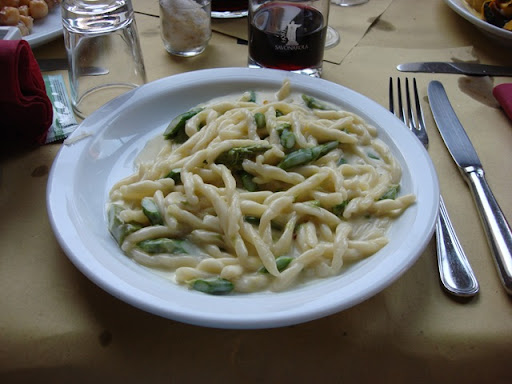
After strolling through the market we found a restaurant with an exterior patio for supper and enjoyed some of the good Italian red wine.  I had a dish of pasta laced with asparagus and a sauce of 4 cheeses.

2008 07 06_0043 - Copy

2008 07 06_0041
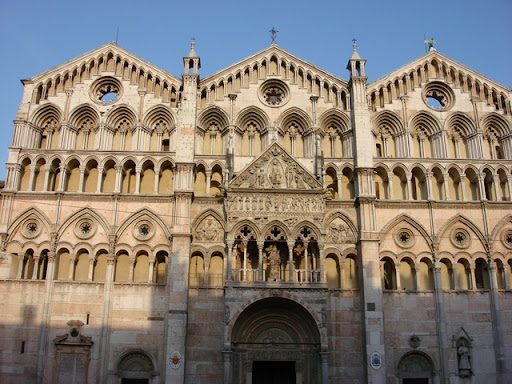
A view of the facade of the cathedral facing the restaurant where we had supper.

2008 07 06_0042

A view of the castle fortress which is surrounded by a moat ( A deep trench around the rampart of a castle or other fortified place, sometimes filled with water ) which faced the restaurant where we had supper.


It was a wonderful end to my first day in Ferrara.