It's funny to read many of the posts from those of us who live in the South at this time of year as so many of them reference the heat. As we all know, many (if not all) homes had kitchens in separate buildings given the risk of fire and the heat. I'm sure Terry could tell us the entire history- I googled quickly and didn't find much. This concept is making a comeback with the Outdoor Living trend and I for one find it quite practical.
While our outdoor kitchen is not quite to the same level as the photo shown above, we do have a trusty stainless steel grill fueled by our gas line. In the summer, we grill almost every night of the week as it's (1) easy prep and cleanup (2) healthy (for the most part) and (3) yummy. Plus, it gives me an excuse to put my herbs to use. Sadly, I've allowed my cilantro to seed and "run" but still... look at the happy herbs!
I was particularly pleased with last night's dinner and thought I'd share- Grilled Corn and Shrimp with Mango Salsa. I totally made this up on the fly, so pardon the round measurements.
First, preheat the grill. Then toss shrimp in plastic ziploc bag with juice from 1 lime or lemon, diced garlic (a tablespoon worth), a healthy pinch of kosher salt, and a splash of olive oil. Keep in fridge.
Start preparing the corn- pull down the husk and remove the silk. It is not imperative that you remove all the silk- the grilling acdtion will make it much easier to remove. Spread margarine lightly on corn and sprinkle with Emeril's seasoning. Note that the corn below is bi-color corn- it looks like it has globs of butter on it but those are really the white kernels!
Pull the husk back over the corn and put on the grill at medium heat. I've tried grilling without the husk and find it much more challenging to manage the cooking time.
Prepare the mango salsa. This will give the flavors a chance to meld. Cut two mangos, add 2 slices worth of chopped red onion, 1/2 jalapeno pepper (remove seeds first), handful of cilantro, 1/4 teaspoon kosher salt, juice of 1/2 lime, and lime zest. Set aside. Run out to grill to turn corn 1/4 turn. If it takes you a while to chop everything, turn the corn in between!
Prepare flavored butter for corn. Mix chopped cilantro, lime zest, and pinch of salt in with butter.
Drink glass of wine with significant other.
Turn corn another quarter turn.
Move corn to cooler part of grill and turn heat up to high. Toss shrimp on grill. Turn corn if needed. Wait 1 minute and flip shrimp.
Corn should look like this. I always poke a few kernels to see how they are. The whole cooking process for the corn should be about 20-30 minutes. Leaving the husks on gives you a lot more flexibility on the cooking time, I think, and increases the likelihood of good moisture.
Plate up the corn and the shrimp. Toss Mango Salsa on top of shrimp. Serve with sliced avocados and a salad!
I took a bit of a break from work Friday and popped up to Gumbo Limbo Gifts in downtown Stuart, Florida. Perhaps I can call it an extended lunch? I had been wanting to visit since seeing the shop and art by Lori Lynn on HGTV's 2009 Green Home (mermaid art, below).
Lori Lynn creates "whimsical art" inspired by sea themes (mermaids, fish, etc) and uses "found" materials.
I then discovered Jean Sanders after I started blogging- and her work is also featured at Gumbo Limbo. Thus, it was settled- I must go.
I have not (yet) been to Key West, but this little section of Stuart seems reminiscent of what I expect Key West to be like. Pictured above is the side street leading up to the shops. I LOVE the color of blue used on the posts! And a cute spot for rent.
Entrance to Gumbo Limbo- the shop owner does such a great job at creating vignettes- even at the front door. Inside, rooms are painted different colors, creating distinct spaces. Shelves in the front room- cute trays, baskets, glassware, Jean's painting, and Lori Lynn's fish. Again, I love the merchandising here.
I believe this is to the right in the front room. I adore the mirror above. Also, the book, Caribbean Elegance, seems a perfect coffee table selection.
The corner of the hallway- again featuring work from both Jean and Lori Lynn as well as furniture, pillows, and other decorative accessories.
The back room with cute furnishings and Lori Lynn's art.
I love this fish piece. The combination of fabrics and using a salvage window- just brilliant.
And I need to buy the tini time sign... I was just worried it wouldn't fit in my suitcase!
Love the orange table and chair with the coral pillow against the blue wall.
And I can't forget this little guy.
In the end, I purchased another Jean Sanders painting, greeting cards, and a few other odds and ends. While you can't really shop online, the person working at the shop (and I forget her name! But so friendly!) said that I could call, reference a piece, and they will ship it to me. So either the fish or the tini time sign will be mine (or both).
Wished that I had made time to stop at the Key Lime Cafe, but this gives me a reason to go back. Honestly, one of the most relaxing, cute places I've been to in a while. Not at all like my typical "stomping grounds" in South Florida. This is a part of Florida that Mr. Southern would appreciate.
-Emmie
P.S. Mr. Southern is going to Delray Beach this week for work. I would love to send him up here!
I commented on another blogger's recent post that I have few photographic images of artwork in my home. So not true! I've realized that much of my "art" are images captured by friends that I've framed and hung. I have just a few pieces of original paintings- though I am working on adding to my collection! The challenge is that I always felt a little "cheesy" buying prints of famous pieces. Especially those with brushstrokes in an attempt to emulate the original.
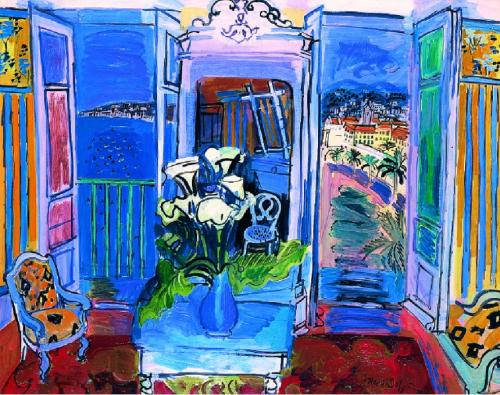
My recent discovery of Raoul Dufy (1877-1953), however, reminds me why people buy prints-- for the love of the art.
Dufy artist was born in Le Havre and began working at the age of 14 at a coffee import company. He was able to study art, however, through evening classes at Le Havre Ecole des BeauxArts at 18. Five years later, he attended the Ecole Nationale des Beaux-Arts in Paris under scholarship.
One of the most fascinating things to me is the variety of mediums Dufy used- oil paintings, water colors, drawings, wood carvings, and textile designs- as well as styles. Monet, Matisse, and Cezanne all served as sources of influences to Dufy.
The Mississippi Museum of Art is hosting an exhibition of Raoul Dufy: A Celebration of Beauty through July 5. (You might have seen Veranda Magazine's feature on the exhibition).
These are just a few samples of his work. Interestingly, it seems that one can find some relatively affordable pieces of his work.
And a personal note- we've been without Internet access all weekend, so I am way behind on blog reading! And check out my new header- from Jean Sanders! Oh- and I owe StyleCourt for my discovery of Dufy. I clicked on her Eudora Welty phototography reference and it took me right to him!
Through almost a comedy of errors, I ended up dining at 3030 Ocean at the Harbor Beach Marriott featuring Chef Dean James Max. Gordon Ramsey fans may recognize the name 3030 Ocean- Paula DaSilva, current Chef de Cuisine- was one of the two finalists in Hell's Kitchen Season 5.
Chef Dean grew up on the Eastern shore of Virginia and South Florida. After earning a degree in Marketing and minoring in Hotel and Restaurant Management at Florida State, Dean studied in Italy. His career continued with positions at notable restaurants up and down the East Coast. Chef is now the Owner/executive chef of several restaurants, including Latitude41 in Columbus, Ohio, and Watertable in Baltimore, Maryland. Notably, he has been included as a semifinalist in both James Beard's 2008 and 2009 Best Chef: South nominations.
He has also written a book about seafood, inspired- I'm assuming- by his lifetime by the water. Of course, I will be purchasing this book now. My dear mother in law, if you are reading this, please forget this post immediately, as I think it could be a lovely coffee table book for you.
I had the opportunity to met Chef at the end of the evening and talk about the Chesapeake Bay, seafood, restaurants, and one of my favorite subjects, the Atlanta Food Scene. It was fabulous. I shared a very edited review of his friend Chef Mennie's new place, Livingston (reviewed earlier this week), Shaun's (on my list!), and discussed Kevin Rathbun- another Atlantan chef for whom I have a ton of respect (met him 2 years ago at the South Beach Food and Wine show. Both he and his brother were fabulous.) Chef mentioned he'd be in Atlanta sometime in August to teach a cooking class. I would LOVE to meet up with him then- how phenomenal to do a restaurant tour in Atlanta with a well-respected chef!? So I gave him my business card. We shall see....
Frottage 1 - 24" x 36" Mixed Media Painting: Pastel, Acrylic, Gesso on Glassine
For this summer's program of continuing education (last summer I studied Architecture in Italy), I have embarked on a course in 'Mixed Media Painting Techniques' at Emily Carr University of Art. The course teaches the process of image-making on built surfaces and works with a range of materials such as gesso, plaster, paint, ink, charcoal, and various papers. I am learning to explore 'expression and emotion' through layering, drawing, brushwork, Frottage and Grattage following in the footsteps of the greats in mixed media painting like: Max Ernst, Mark Rothko, and Paul Klee. I particularly like my teacher, Diana Kubicek's style of teaching. She teaches us to explore the various techniques fearlessly and says repeatedly there are "no mistakes"in painting. As a matter of fact "mistakes can be the building block of a great masterpiece". I like that! I have always been interested in drawing and sketching since my days in Design School, but find that I never have the time to take a brush to paper and do larger abstract paintings and works of art. So this course is a perfect opportunity to allow myself the freedom to explore different mixed media painting techniques. The last class we spent exploring the technique of Frottage (from French frotter, "to rub") a surrealist and "automatic" method of creative production. Frottage was developed by Max Ernst.
Frottage 2 - 18" x 24" Mixed Media Painting: Ink, Acrylic & Pastel on Paper
In frottage painting the artist takes a pencil or other drawing tool and makes a "rubbing" over a textured surface. The frottage drawing can be left as is or used as the basis for further refinement (which we are supposed to do for homework with the pieces we created in this class). While this technique is superficially similar to brass rubbing and other forms of rubbing intended to reproduce an existing subject, frottage painting differs in being aleatoric and occurring by chance. Frottage was developed by Max Ernst in 1925. Ernst was inspired by an ancient wooden floor where the grain of the planks had been accentuated by many years of scrubbing. The patterns of the graining suggested strange images to him. He captured these by laying sheets of paper on the floor and then rubbing over them with a soft pencil. In my Frottage Paintings 1, 2 and 4 the textured surface that I used to make the Frottage rubbing was a bamboo mat, string, and screen. In Frottage Painting 3, I did the rubbing over a Gessoed canvas that was prepared with the free form focus on the bark of a tree. As I was doing Frottage Painting 3, rubbing on the Gessoed canvas, it slowly evolved to resemble a Japanese mountain landscape with a waterfall collecting into a pool at the base of the mountain. Our teacher guided us in exploring this technique in creating our Frottage paintings which is based on Surrealist automatism*.*Automatism is a surrealist technique in painting, practiced without conscious aesthetic or moral self-censorship. Automatism has taken on many forms: the automatic painting and drawing initially (and still to this day) practiced by surrealists can be compared to similar, or perhaps parallel phenomena, such as the non-idiomatic improvisation of free jazz.
Frottage Painting 3 - 18" x 24" Pastel on tracing paper
Frottage Painting 4 - 12" x 18" Mixed Media Painting: Acrylic & Gesso on paper
In the first class we explored the technique of mixed media painting starting with a base of Gesso
Study 1 - 11" x 14" Mixed Media Painting Technique: Gesso, Acrylic and Watercolor on Card Stock
Gesso is an art supply used as surface preparation or primer for painting and sculpting. Gesso is believed to have been developed in Italy, since the word gesso is Italian for 'chalk'. Preparation varies according to intended use, but usually consists of mixing glue with plaster, chalk, or gypsum. (Gesso is the perfect base for starting a mixed media painting.)
Gesso resembles paint, but is thinner and dries hard. Gesso is applied with a brush and must dry before the surface can be painted. This technique of applying Gesso was first created for use in painting, in order to give the surface the right properties to receive paint. In Gothic and Renaissance panel painting, the technique of applying gesso over a panel of wood was used in order to give the paint something to adhere to. It created a slightly rough surface and prevented the paint from seeping into the wood. We were taught to apply the Gesso to our surface of our mixed media painting with a palette knife using broad strokes to building up the surface. Then various tools are used to create the textures. In Study 1 I used a metal clay sculpting tool with a comb like ridge to scrape across the wet Gesso. I then used the edge of my pallet knife to scrape in the diagonal ridges, then finished off with blotting areas with a sponge. I let the piece dry and then applied watercolor and acrylic in layers to the painting, while at the same time using a roller to take off the excess wet color on the surface so that the paint pigment settled into the crevices of the Gesso. I used the side of my palette knife to scrape off the raised portions of the diagonal lines to reveal the white Gesso below - a technique called Grattage*. Also the Gesso doesn't extend to the edge of the paper and gives it an interesting border. *Grattage is a surrealist technique in mixed media painting in which (usually dry) paint is scraped off the canvas. It was employed by Max Ernst and Joan Miró
Detail of Mixed Media Painting Technique: Study 1 above.
Study 2 - 10" x 10" Mixed Media Painting Technique: Masking Tape, Gesso and Watercolor on Glass
Study 3 - 7" x 10" Mixed Media Painting Technique: Gesso and Watercolor on Paper
Have you had any experience with Mixed Media Painting, Frottage or Grattage or other Mixed Media techniques? Please let me know by leaving a Comment.
I was delighted to find that Elle Decor featured Rita Norena Schrager's Southampton home, "inspired by the snowy palette of the Delano Hotel." Yes, the last name is no coincidence. Ms. Schrager's ex-husband is famed hotelier Ian Schrager.
The Delano is absolutely one of my favorite hotels and given that I was reading while en route to South Florida, I found the article very apropos.
My first reaction was to second-guess just how much inspiration The Delano actually provided. After all, one is heavily influenced by the surrounding Art Deco area, while the other is, well, Hamptons-style! Upon review, however, there are some interesting correlations. What do you think?
CAUTION: This is a very image-rich post!
Exterior
Front Porch
Delano Entrance
Delano Front Porch
Living Room
Delano Lobby
Delano Bungalow
Delano Apartment
Foyer
Delano Florida Room
Kitchen
Delano Rose Bar
Delano Blue Door
Dining Room
Blue Sea
Library
Lobby
Florida Room
Daughter's Bedroom
Delano Agua Spa
Master Bedroom
Delano Room
Delano Oceanside Room
Delano Suite
Master Bath
Delano Agua Spa
Pool
Delano Pool
Playhouse
Delano Bungalows
So what do you think? See any similarities? Regardless, I'll take either.


 Prepare flavored butter for corn. Mix chopped cilantro, lime zest, and pinch of salt in with butter.


 I have not (yet) been to Key West, but this little section of Stuart seems reminiscent of what I expect Key West to be like. Pictured above is the side street leading up to the shops. I LOVE the color of blue used on the posts! And a cute spot for rent.
 Entrance to Gumbo Limbo- the shop owner does such a great job at creating vignettes- even at the front door.
 Inside, rooms are painted different colors, creating distinct spaces. Shelves in the front room- cute trays, baskets, glassware, Jean's painting, and Lori Lynn's fish. Again, I love the merchandising here.
 I believe this is to the right in the front room. I adore the mirror above. Also, the book, Caribbean Elegance, seems a perfect coffee table selection.
 The back room with cute furnishings and Lori Lynn's art.
 I love this fish piece. The combination of fabrics and using a salvage window- just brilliant.
 And I need to buy the tini time sign... I was just worried it wouldn't fit in my suitcase!
 And I can't forget this little guy.
 Wished that I had made time to stop at the Key Lime Cafe, but this gives me a reason to go back. Honestly, one of the most relaxing, cute places I've been to in a while. Not at all like my typical "stomping grounds" in South Florida. This is a part of Florida that Mr. Southern would appreciate.





 Exterior
 Front Porch

 Living Room

 Delano Apartment
 Foyer
Foyer Delano Florida Room
 Kitchen


 Daughter's Bedroom
 Master Bedroom


 Pool
Pool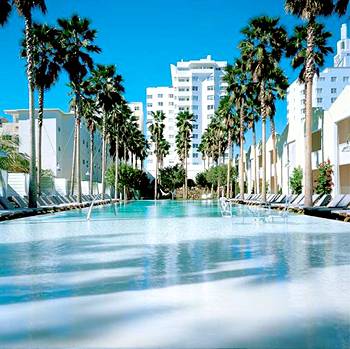


 Posts
Posts


